The New Southeast Asian Production Map
China, Japan and the Reordering of ASEAN Supply Chains
ASEAN attracted approximately US$226 billion in foreign direct investment in 2024, just US$5 billion short of its 2022 record, while manufacturing FDI surged nearly 150% year on year. MSA's report argues China+1 is now better understood as China+N: a distributed China-ASEAN production architecture, with different countries absorbing different stages of production rather than functioning as interchangeable alternatives.

What's Inside
SELECTED CONTENTSKEY FIGURES
China+1 Has Changed
Why the simple diversification story is now incomplete, and what China+N actually means.
Country Platforms: Thailand, Vietnam, Malaysia
Displacement in real time, the assembly platform, and the neutral hub, assessed individually.
Sector Deep Dives
Automotive, electronics, and batteries and critical minerals, where the displacement is sharpest.
Who Wins and Who Loses
The new investment decision framework and what it means for foreign companies now.
The MSA Framework and Scenarios to 2030
A structured way to evaluate any ASEAN production location against where this is heading.
About the Author
MSA RESEARCHReport Preview
SAMPLE PAGE · CLICK TO ENLARGE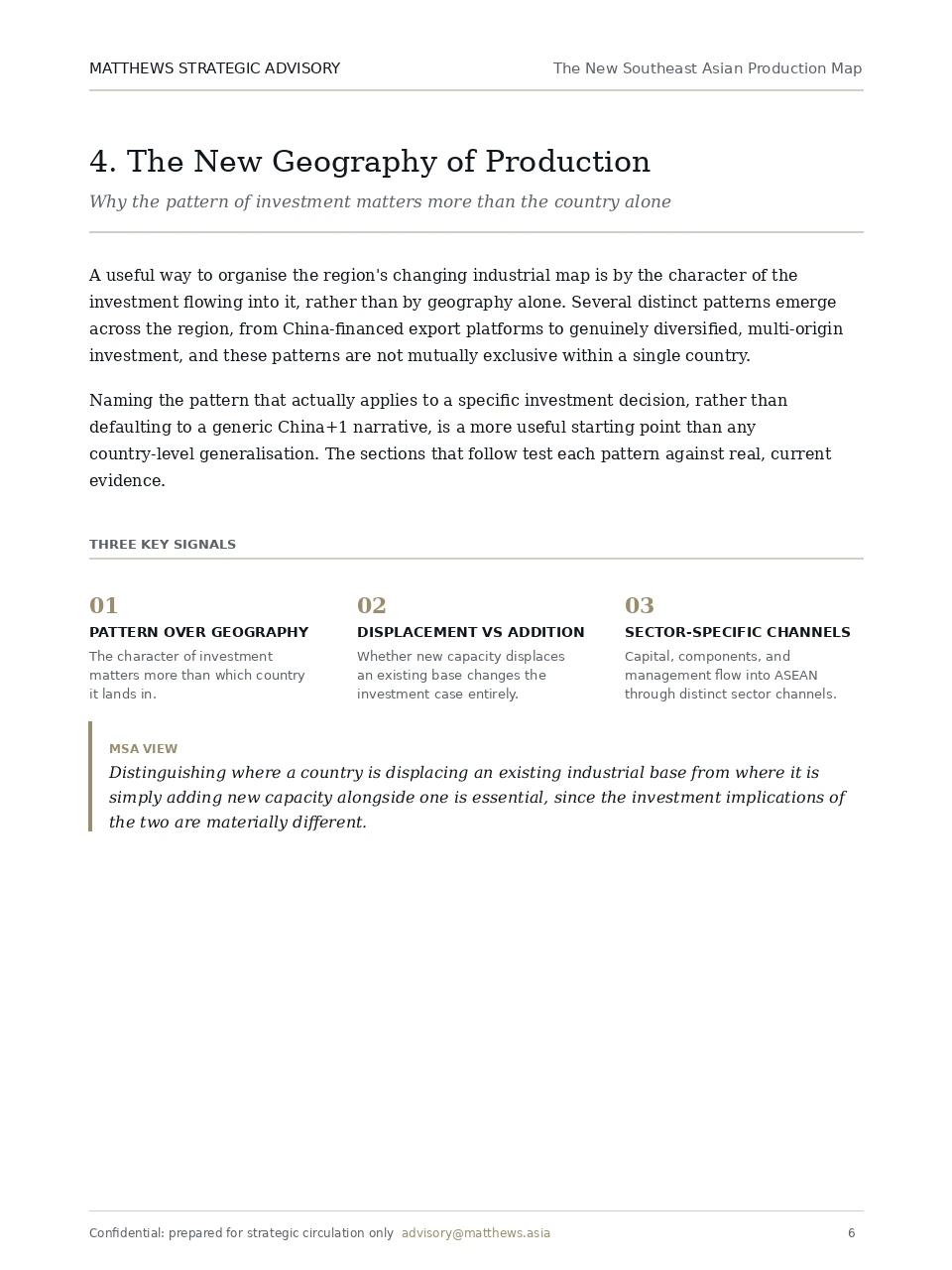
Section 4, The New Geography of Production, reproduced as it appears in the full report.
Choose Your Licence
Single-reader access, or company-wide distribution for your team.
- Full PDF report
- All exhibits and data
- Single named reader
Instant delivery via email
- Everything in Single-Reader
- Internal distribution across your organisation
- Priority advisory follow-up
advisory@matthews.asia
Need advisory support alongside this report? See our engagement options
Why MSA
- Evidence-tiered. Every claim is sourced and labelled by evidence strength: verified, corroborated, or intelligence gap.
- Institutional-grade. Built to the same design and rigour standard across MSA's entire research library.
MSA Research, Matthews Strategic Advisory, Bangkok & Hong Kong
Southeast Asia · Greater Mekong · Greater China
Not Legal or Financial Advice
This report is strategic intelligence and market analysis, not legal, tax, or financial advice. All figures should be independently verified before any capital allocation decision.
Frequently Asked Questions
FAQWhat is China+N and how is it different from China+1?
China+1 describes companies diversifying manufacturing away from China into a single alternative country. China+N describes a distributed system where China supplies capital, components, technology, and management across multiple ASEAN countries simultaneously, each absorbing a different stage of production.
Which countries does this report cover in detail?
Thailand, Vietnam, Malaysia, Indonesia, Cambodia and Laos, and the Philippines each receive dedicated country analysis, alongside sector deep dives in automotive, electronics, batteries and critical minerals, industrial machinery, and logistics infrastructure.
Is this report about avoiding China, or about China's expanding role in ASEAN?
The latter. The report's central finding is that Chinese companies are increasingly embedded in ASEAN's manufacturing build-out as investors, technology providers, and component suppliers, not simply displaced by it.
What is the MSA Framework mentioned in the report?
A structured evaluation framework for assessing any specific ASEAN production location or investment decision against the distributed China+N architecture described throughout the report, rather than treating each country as an isolated choice.
Who should buy this report?
Institutional investors, corporates, and operators evaluating Southeast Asian manufacturing and supply-chain strategy, including companies currently mid-way through a China+1 relocation decision.
Related Research
CONTINUE EXPLORINGHong Kong's Southeast Asia Strategy 2030
The capital and financing side of the same China-ASEAN production shift mapped here.
The Growth Beneath the Headline
Thailand's own three-speed economy, a country-level companion to the regional map covered here.
The Labour Gap
Migrant workforce dependency across the same manufacturing platforms assessed in this report.