Hong Kong's Southeast Asia Strategy 2030
Positioning Hong Kong for the Next Phase of ASEAN Growth
ASEAN has been Hong Kong's second-largest merchandise trading partner for 16 consecutive years, with bilateral trade reaching approximately US$214 billion in 2025, up 29% year on year. MSA's report argues the opportunity ahead cannot be secured through trade promotion alone: Hong Kong must position itself as the capital, structuring, and internationalisation platform connecting China and global capital with Southeast Asia's next investment cycle.

What's Inside
SELECTED CONTENTSKEY FIGURES
Five Principal Findings
Why Hong Kong's strongest proposition is capital, not operations, and what that means strategically.
Hong Kong Versus Singapore
A dual-hub model, not a head-on contest: where each city's advantage actually lies.
The China-Hong Kong-ASEAN Corporate Corridor
The emerging two-way capital model, illustrated with a live transaction case study.
Priority ASEAN Markets
A tiered strategy across nine markets, reflecting genuine differences in scale and strategic fit.
2030 Scenarios and Strategic Priorities
Passive, active, and strategic paths, and the five priority actions that separate them.
About the Author
MSA RESEARCHReport Preview
SAMPLE PAGE · CLICK TO ENLARGE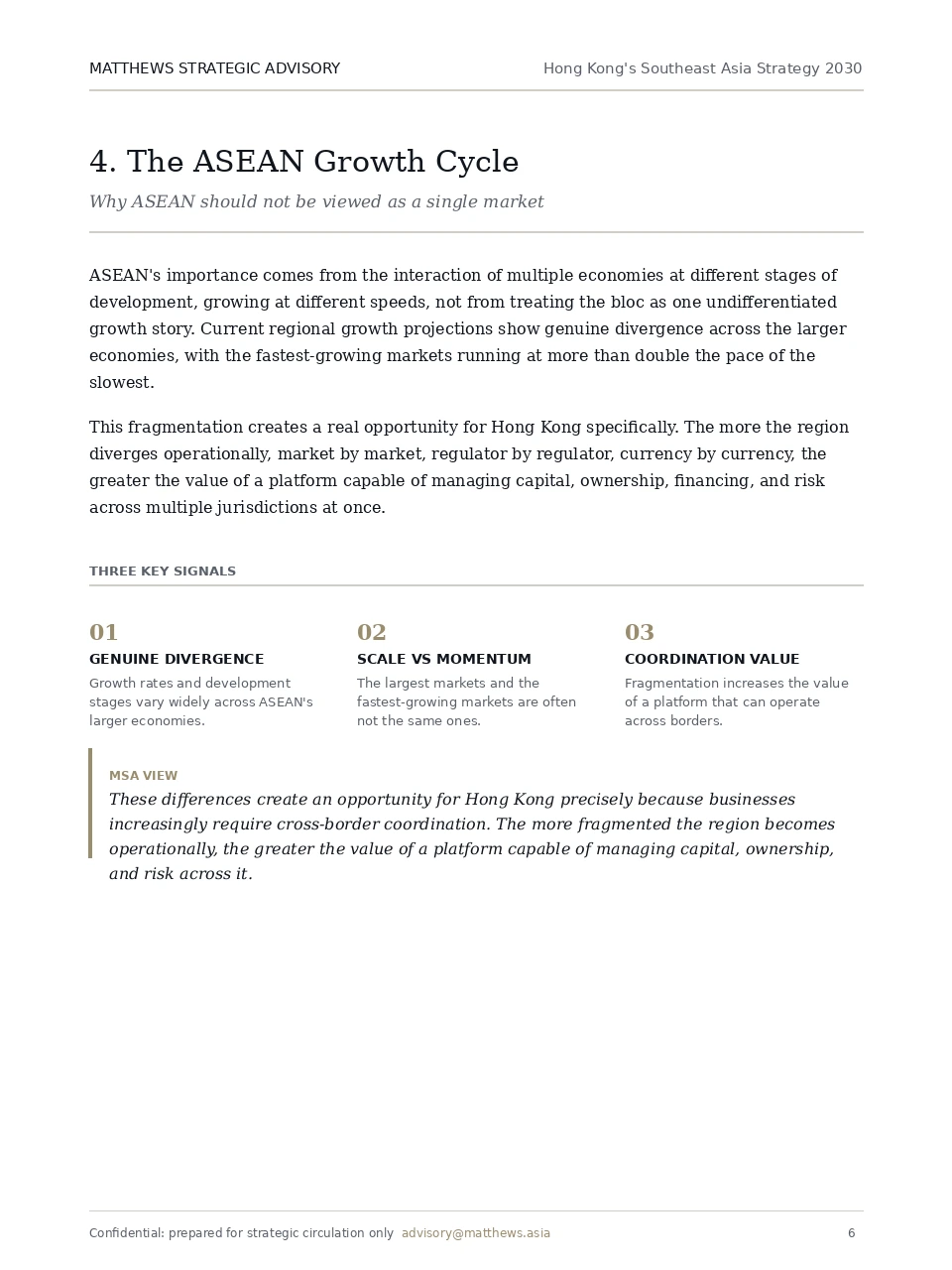
Section 4, The ASEAN Growth Cycle, reproduced as it appears in the full report.
Choose Your Licence
Single-reader access, or company-wide distribution for your team.
- Full PDF report
- All exhibits and data
- Single named reader
Instant delivery via email
- Everything in Single-Reader
- Internal distribution across your organisation
- Priority advisory follow-up
advisory@matthews.asia
Need advisory support alongside this report? See our engagement options
Why MSA
- Evidence-tiered. Every claim is sourced and labelled by evidence strength: verified, corroborated, or intelligence gap.
- Institutional-grade. Built to the same design and rigour standard across MSA's entire research library.
MSA Research, Matthews Strategic Advisory, Bangkok & Hong Kong
Southeast Asia · Greater Mekong · Greater China
Not Legal or Financial Advice
This report is strategic intelligence and market analysis, not legal, tax, or financial advice. All figures should be independently verified before any capital allocation decision.
Frequently Asked Questions
FAQWhy should Hong Kong care about ASEAN when Singapore already dominates regional headquarters?
The report's central argument is that Hong Kong should not compete with Singapore on regional headquarters. Hong Kong's stronger, more defensible proposition is as the China-facing capital and structuring platform, a genuinely different role that complements rather than competes with Singapore's.
Is this report only relevant to government and policy audiences?
No. While the report's circulation includes government and policy bodies, its analysis and recommendations are directly relevant to institutional investors, corporates, and professional-services firms assessing their own Hong Kong-ASEAN positioning.
What is the China-Hong Kong-ASEAN corporate corridor?
A framework describing how capital, both Chinese and international, increasingly flows to ASEAN through Hong Kong's financing, structuring, and professional-services functions, illustrated in the report with a live 2026 transaction.
Does the report cover all ASEAN markets equally?
No, deliberately. The report applies a tiered approach, with Indonesia, Vietnam, Malaysia, and Thailand receiving the most detailed treatment as the largest realistic near-term opportunity. Myanmar is treated separately as a specialist, higher-risk case.
Who should buy this report?
Government and policy bodies shaping Hong Kong's external economic strategy, institutional investors and corporates with a Hong Kong-ASEAN dimension to their strategy, and professional-services firms advising on cross-border China-ASEAN transactions.
Related Research
CONTINUE EXPLORINGThe New Southeast Asian Production Map
How China and Japan are reordering ASEAN supply chains, a manufacturing-side view of the capital flows covered here.
Myanmar's Coming Commercial Realignment
The specialist, higher-risk market tier referenced in this report's priority-market framework.
Regional Risk and Opportunity Briefing
China's consumption slowdown and cross-strait risk, both directly relevant to Hong Kong's China-facing positioning.