Hong Kong’s First Five-Year Plan: The Northern Metropolis, the Greater Bay Area and the Belt and Road
On 16 September 2026, Hong Kong published its First Five-Year Plan for Economic and Social Development (2026–2030), aligned with the national 15th Five-Year Plan. This briefing sets out what the plan commits to in the three areas that matter most to investors and corporates looking at Hong Kong and its links to the Mainland and Southeast Asia.
The plan at a glance
The plan runs to seven parts and 28 chapters, with 105 development indicators. The Government has said the annual Policy Address will serve as the yearly report on its implementation. Its seven parts are:
- Open up New Horizons and Unfold a New Chapter
- Strengthen the Four Centres, Develop the Hub for High-calibre Talent
- Expedite the Development of the Northern Metropolis and Spearhead Spatial Layout Optimisation
- Deepen the Development of the Guangdong-Hong Kong-Macao Greater Bay Area and Create an International Collaboration Network
- Enhance Social Well-being and Refine the Social Protection Framework
- Adopt a Holistic Approach to Development and Security, Enhance Public Governance Efficacy
- Strengthen the Institutional Safeguards for Effective Implementation
| Selected headline targets | Baseline | Target |
|---|---|---|
| Spending on innovation activities, % of GDP | 1.63% (2024) | 3% after 2030 |
| Manufacturing and new industrialisation, value added % of GDP | 3.8% (2024) | 5.5% after 2030 |
| Northern Metropolis spade-ready sites | Not stated | 900 hectares, 2026–27 to 2030–31 |
| Northern Metropolis housing completions | Not stated | 70,000 units, 2026–27 to 2030–31 |
| Airport destinations | 220 | 240 within five years |
| Non-local post-secondary students | 79,800 (2024–25) | 100,000 by 2029–30 |
| Zero-carbon energy share | 25% (2024) | 30% by 2030 |
The Northern Metropolis
Part 3 gives the Northern Metropolis three chapters: the Northern Metropolis University Town, a technology-driven industry-academia-research innovation system, and the development of a metropolis for living, work and travel. The plan names the Hetao Shenzhen-Hong Kong Science and Technology Innovation Co-operation Zone as a core platform and commits to an advanced research and pilot-production base for technology industries.
The most important commitments for investors are the delivery numbers: 900 hectares of spade-ready sites and 70,000 housing completions in the Northern Metropolis over the five years to 2030–31.
MSA view. Dated land and housing targets move the Northern Metropolis from a long-range vision to a delivery programme with milestones the market can track. The practical questions for investors are sequencing: which zones come forward first, for which uses, and on what terms private capital is invited in.
The Greater Bay Area
Part 4 commits Hong Kong to deeper integration with the Guangdong-Hong Kong-Macao Greater Bay Area across five areas: innovation and technology cooperation; “hard connectivity” of infrastructure; “soft connectivity” through alignment of rules and mechanisms, including with high-standard international economic and trade rules; connectivity between residents; and the major cooperation platforms at Qianhai, Nansha and Hetao. Specific measures include port and airport cluster cooperation and a cross-boundary low-altitude logistics network.
MSA view. The Northern Metropolis sits on the boundary with Shenzhen, and Hetao appears in both the Northern Metropolis and Greater Bay Area chapters. Greater Bay Area integration is the demand engine for the Northern Metropolis, so progress on rules alignment and cross-boundary flows is the leading indicator to watch.
The Belt and Road and ASEAN
A dedicated chapter commits Hong Kong to cooperation under the Belt and Road Initiative. The plan says Hong Kong will further cultivate the ASEAN and Middle East markets, attract long-term capital from the Middle East, ASEAN, Europe and America, and continue to seek accession to the Regional Comprehensive Economic Partnership (RCEP) as early as possible. It also targets air services links with Belt and Road partner countries, offshore renminbi services for emerging markets, and support for enterprises from partner countries developing the Mainland and Asian markets.
Alongside this, the trade chapters commit to a two-way service platform for overseas enterprises entering the Mainland and for Mainland enterprises going global, and the plan targets average annual growth of 4–5% in companies with regional headquarters or offices in Hong Kong.
MSA view. For Southeast Asia, the plan formalises Hong Kong’s role as the capital, structuring and services platform between the Mainland and ASEAN. RCEP accession would be the most material single step for ASEAN-facing trade and investment. Corporates choosing a regional base, and ASEAN businesses seeking Mainland or international capital, should read the plan as a statement of where Hong Kong will concentrate policy support.
What it means
- Investors and family offices: the Northern Metropolis now has dated land and housing targets, and innovation and technology carry the plan’s most ambitious numbers.
- Corporates setting up in Hong Kong: policy support for regional headquarters, the Greater Bay Area and Mainland access is now set out in a five-year framework.
- ASEAN businesses: Hong Kong is positioning as the route to Mainland markets and to international and Middle East capital, with RCEP accession as a stated objective.
- Mainland enterprises going global: Hong Kong’s services, financing and legal platform is the plan’s intended gateway into Southeast Asia.
For live US trade actions on Southeast Asia, tariff lookups and regional market data, Matthews Terminal is free with an account.
Go deeper with MSA research
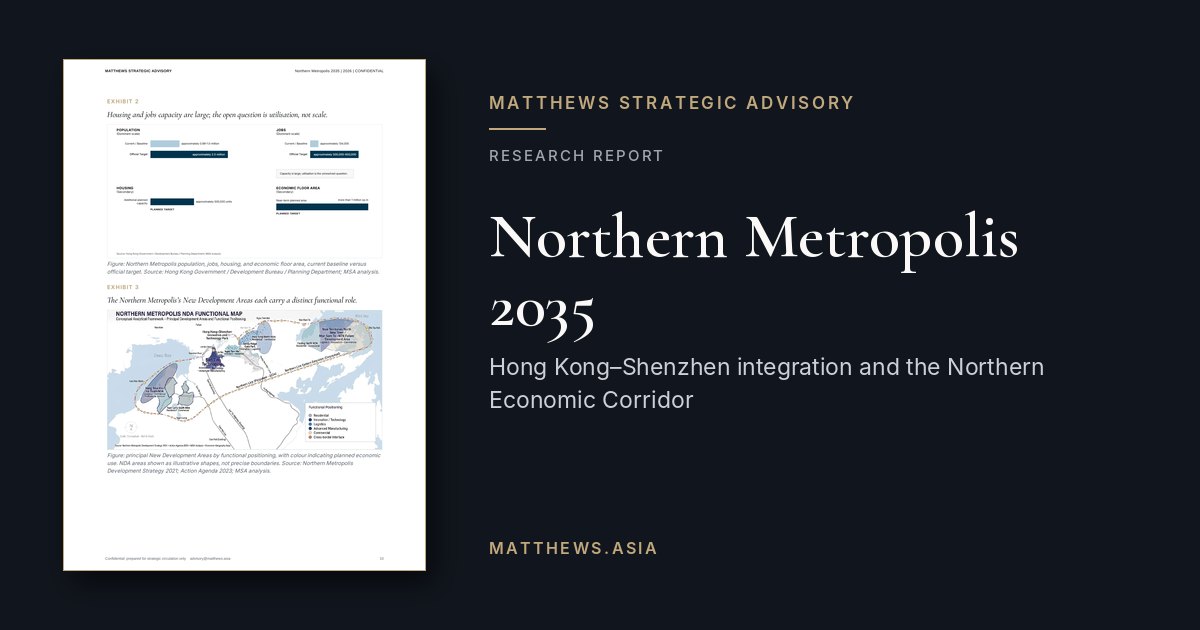
Northern Metropolis 2035
Hong Kong-Shenzhen integration, capital reallocation and the Northern Economic Corridor, revised after the 16 September 2026 Policy Address.
View report →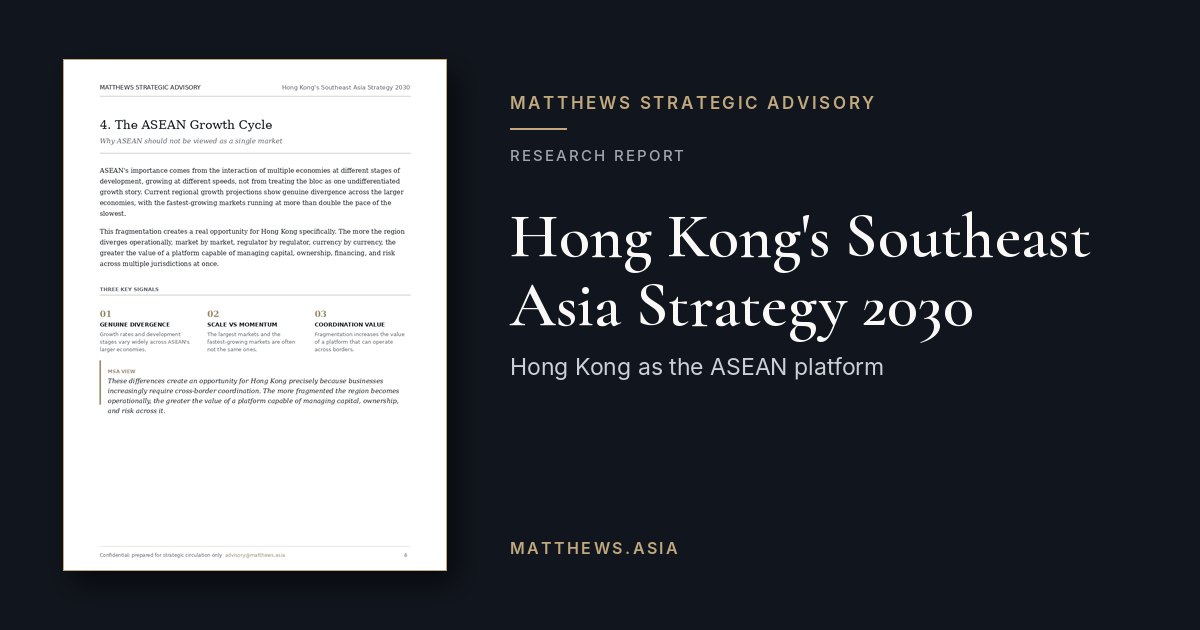
Hong Kong’s Southeast Asia Strategy 2030
Hong Kong as the capital and structuring platform between the Mainland and ASEAN.
View report →Sources
- HKSAR Government, The First Five-Year Plan for Economic and Social Development of the Hong Kong Special Administrative Region (2026–2030), full text.
- HKSAR Government press release, 30 July 2026.
- China Daily Hong Kong, 18 September 2026.
This briefing summarises published government documents and MSA’s independent reading of them. It is for information only and is not investment, legal or tax advice.